

The real limits of AI in B2B marketing
I use AI all the time. Everything from designing a shed, to getting tantrum advice for a sassy two-year-old, through to checking the flow of sentences in blogs.
For me, it helps me get unstuck in those proper head scratchy moments. I find it incredibly useful.
But after a conversation with my co-founder Kerry Leech recently, I think a lot of businesses are starting to confuse faster content production with better content.
We both lead on content strategy at Roo & Eve, but Kerry is our resident content super geek and genuinely reads SEO, AI-search and buyer behaviour studies for fun.
I asked her a few questions about what she’s seeing. Here's what she said ⬇
Q: What evidence is there that AI-generated content is hurting Google rankings and what’s actually causing it?
“A lot of the evidence is pointing in the same direction.
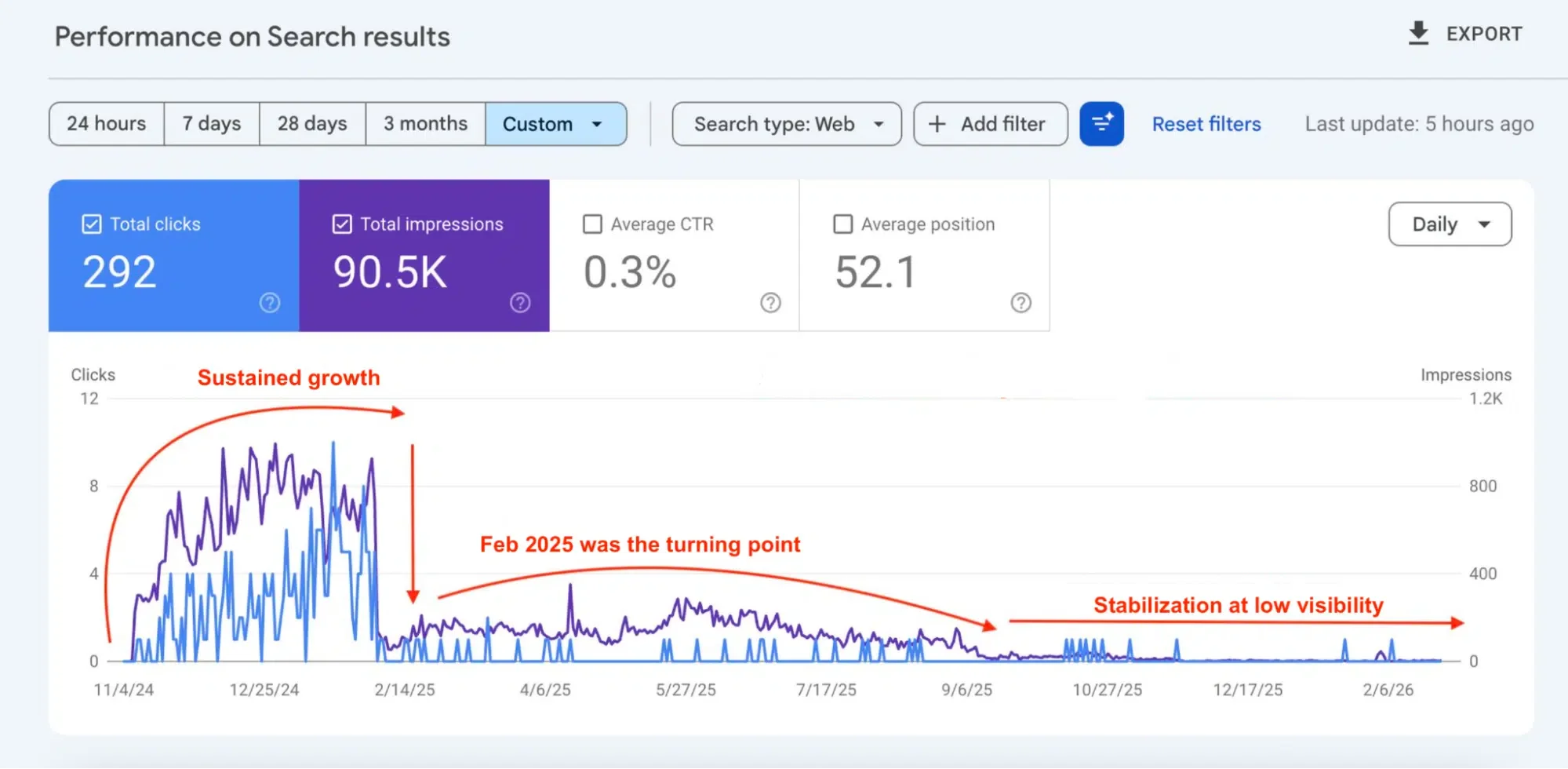
A 16-month Search Engine Land / SE Ranking experiment tracked 2,000 AI-generated articles across new sites. Most followed the same trajectory: early traffic spikes, then a steep drop.
Semrush also analysed 42,000 blog posts and found position-one Google results were 8x more likely to be human-written than AI-written.
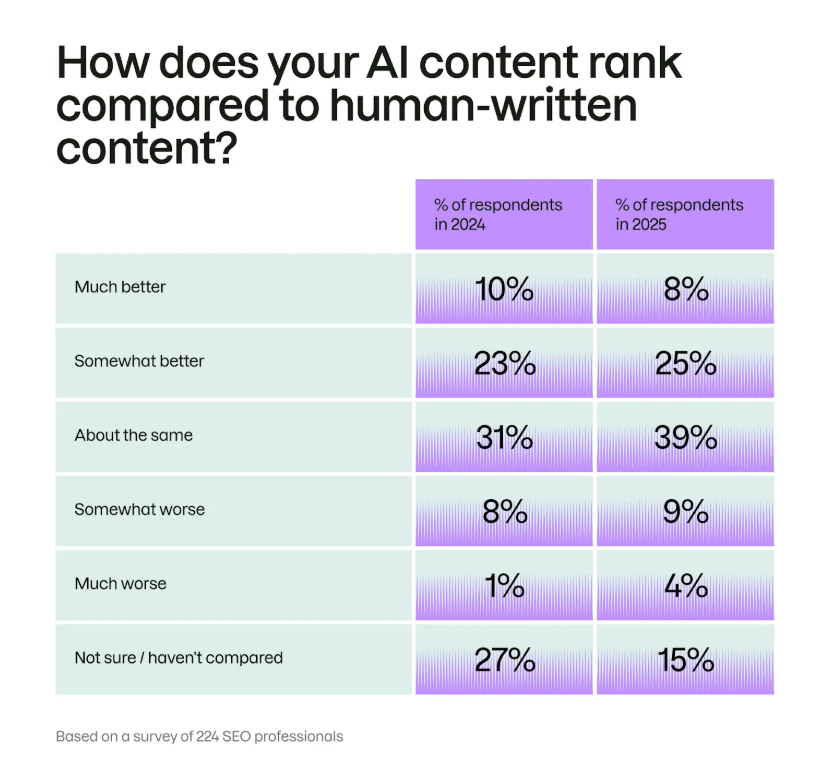
So, is AI-generated content a big no-no? No. That isn't the issue itself.
Google’s own guidance says generative AI can be useful for research and structuring original content. The problem is using AI to generate lots of pages without adding real value, which can fall under scaled content abuse.
What’s really hurting rankings?
No original insight.
No expert input.
No clear point of view.
No first-hand experience.
No evidence. No trust signals.
No reason for anyone to bookmark, share, cite, or come back.
AI can speed up production. But it can’t tell you what your buyers care about, what your market is tired of hearing, or what makes your company credible.
That still comes from people.
Interestingly, a recent Gartner study found that while 80% of companies surveyed had reduced headcount alongside automation projects, there was no clear link between those cuts and stronger returns. So, the companies seeing the strongest results were using the technology to make their teams more effective and more productive.
That feels pretty relevant to content, too. The best results usually come when good tools support expertise and strengthen the people behind the work."
Q: What recent trend made you rethink conventional marketing advice?
“Buyer research behaviour has changed faster than most marketing teams have adapted to. People are getting answers from ChatGPT, Reddit, LinkedIn, YouTube, review platforms, analyst sites, Slack groups, and communities long before they visit a company website.
Of course, a company website is still a key part of the buyer journey. It just isn’t the only place buyers form opinions anymore.
And that changes the role of content.
Publishing blogs and waiting for Google traffic is no longer enough on its own. Brands now need visibility and credibility across the places buyers already spend time.
The companies doing this well usually have:
Clear positioning.
Subject-matter experts involved in content.
Strong customer proof.
Consistent messaging across channels.
Useful answers to specific buyer questions.
Distribution beyond organic search.
The same themes keep appearing across recent AI-search and SEO studies: expertise, evidence, reputation, consistency, and genuinely useful information.”
Q: So what does good content actually look like now?
“A lot of the advice emerging around AI-search optimisation is really pointing brands back towards good marketing fundamentals.
Clear answers. Useful information. Strong structure. Evidence. Expertise.
One of the biggest changes we see is that content now has to work both for people and for AI systems interpreting it.
That means answering questions directly, using clear headings, adding useful summaries, citing credible sources, showing who wrote the content and why they’re qualified to talk about it.
The brands doing well are usually the ones proving things properly. Case studies. Customer evidence. Expert commentary. Data. Accreditations. Original thinking.
AI tools are getting very good at spotting the difference between content that says something and content that actually knows something.”
Q: Why are Roo & Eve well placed in this market for content?
“Because good B2B content still depends on judgment. Especially in technical sectors.
We understand how buyers think in financial services, credit risk, banking, data, and B2B tech. We know how to work with SMEs, find the commercial angle, simplify technical ideas without flattening them, and create content people actually trust.
That's super important more now because AI has lowered the barrier to producing average content.
And, let's be honest, we've already had enough average content.
So, the companies getting attention today are usually bringing one of three things:
Expertise. Experience. Evidence.
Ideally, all three.”
Key takeaway
One thing Kerry said that stuck with me was this:
AI has made content easier to produce. It hasn’t made good judgment easier.
And in B2B marketing, especially in technical industries, judgment is usually the difference between content that gets ignored and content that actually influences buying decisions.
Based on ideas from our internal research notes on AI-search optimisation and content trust signals.