

We're still measuring B2B content like it's 2015
One question came up more than any other in our client conversations this month:
"How do we know if our content is actually working?"
It usually starts with a metric.
"Our newsletter open rate has dropped."
"This blog only had 20 views."
"Only a handful of people downloaded our ebook."
On the face of it, those numbers don't look particularly encouraging. But do they actually tell you whether your content is succeeding?
Not necessarily.
At Roo & Eve, we're lucky enough to spend a lot of time inside our clients' marketing data. Alongside platforms like Dreamdata, we're able to look beyond page views and click-through rates to see which content actually appears in buyer journeys before pipeline and revenue are generated.
Some of what we've found confirms what we'd expect. Some of it has completely challenged our own assumptions.
So, I sat down with our co-founder and Content Strategy Director, Kerry Leech, to talk about what she's learned from analysing client data, and why she believes many B2B marketers are still measuring content like it's 2015.
We still judge blogs by traffic
One of the biggest assumptions Kerry challenged was the idea that your highest-performing blog is the one with the most page views.
"Yeah, I definitely think the biggest mistake is probably vanity metrics. There's always been too much focus on those anyway. Too often, people prioritise content which is pulling in the most traffic. But I think that can be a mistake."
She explained that across our clients, the blogs that attract the most traffic are often broad, top-of-the-funnel pieces that don’t always convert well.
"In my analysis across clients, the content pulling in the most traffic tended to be top-of-the-funnel pieces, like 'What is resource management?', for example. While these pieces pulled in a lot of traffic, they didn't tend to be the right audience, because a buyer isn't going to be asking what the topic is, because they live it every day. It's more likely to be junior people or people from different departments, for example."
Instead, she looks for a different set of signals.
"What we found is that when we go really niche on content, and we address very specific pain points for very specific sectors and verticals, the content might get only 10 views a month. But time on page is normally really high. That's my first indicator, and then if the client has something like Dreamdata set up, you can actually see that it is part of the buyer journey before they book a demo or whilst they're in the pipeline and they're still waiting to convert to revenue."
Of course, some content pieces are there to build awareness. Others help buyers answer very specific questions as they get closer to a decision. Looking at page views alone won't tell you which content is helping generate pipeline. That's where engagement metrics, buyer journey data, and attribution start to paint a much more complete picture.
We still judge newsletters by opens and clicks
Newsletter performance is another area where Kerry thinks marketers can be too quick to jump to conclusions.
Clients often ask us what counts as a "bad" open rate or click-through rate, and if it's time to rethink their newsletter strategy. Kerry's answer is that it's not that straightforward.
"First of all, newsletters were something done really well back in 2015. I actually used to run a newsletter programme that was all I did for my job for some time, and it was given so much love and attention. It generated millions in influenced revenue because it was done so well and so intentionally."
That intention is what she believes is often missing today.
"Newsletters have to be approached with a really well-considered strategy and thought process behind each month. It's not just a case of, 'Oh, this is just another channel, let's just bang all these blogs on it without any consideration.”
When it comes to reporting, Kerry is cautious about putting too much weight on opens and clicks alone.
"I think it's really hard to go by metrics like opening and click rates, because we do know that some audiences have filters etc. on, so it's hard to know if someone did open or click sometimes, because the tracking and the attribution are difficult."
Instead, she'd start by looking at how much attention the newsletter is getting overall.
"I think the first place I would start is to see how much love it's getting. Then I'd look at the data and see how it's performing. Sometimes it can be simple tweaks that's needed to CTAs etc."
There's another factor to consider too.
"Another consideration is how a lot of newsletters, particularly if they're on LinkedIn, are zero-click. Click-through rate is something that I think is getting less relevant in some ways, because actually a lot of people are wanting to stay on the platform or aren't wanting to click and just want the information given to them there and then in the media they're in."
It's another reminder that a single metric doesn’t tells the whole story. Before deciding a newsletter needs a complete overhaul, it's worth thinking about how your audience consumes content, how much your reporting captures that behaviour, and if your newsletter has a purpose beyond sharing the latest blogs.
We still gate too much content
The same theme came up when we talked about gated content.
For Kerry, this comes back to the way many businesses measure marketing success.
"Yes, 100%, it's the metrics. It's like going back to the metrics again and how the board just wants to see metrics without considering the B2B buyer journey and how people actually engage with content."
She believes too many businesses are still putting valuable content behind forms when they could be using it to build trust and reach more buyers.
"People want to gate such a lot of stuff that actually really shouldn't be gated. It's just adding more friction."
In our view, blogs should never be gated. They're there to build visibility through search and help buyers find answers when they're researching. Guides and ebooks are different, but only if they're genuinely valuable enough that someone is happy to exchange their details for them, like original research or benchmark reports.
Kerry also pointed out that easy access to AI tools is changing buyer behaviour.
"In some ways, it's worse with easy access to LLMs like ChatGPT and Claude, et cetera. People are just going in there and asking them, 'How do I know this is working?' Obviously, the LLM tools haven't got the experience, so they don't know that it's not all about click-throughs and open rates, but about that consideration within the B2B buyer journey. Because we don't know where buyers are in the B2B journey, and if we're forcing them into funnels rather than being always on and always helpful, then they don't tend to be the best leads."
One example really stuck with her.
"I remember reading about a company that spent £15,000 over five weeks promoting a gated ebook. They got 106 downloads, of which half of them gave fake email addresses. A third downloaded it to avoid looking uninformed in a meeting, not because they wanted to buy anything."
When the company looked at what happened, the picture was very different.
"3,400 people landed on the ebook page, and only 3% filled out the form. They were actively preventing 97% of interested visitors from ever engaging with their content."
The company decided to ungate everything.
There was plenty of internal pushback.
"How will we generate leads? What are we showing in reports to the board? How do we prove marketing is working? That's the problem again. It's all about the metrics."
Instead of reporting on leads, they started reporting on pipeline and revenue.
The results after a year were pretty impressive:
265% increase in demo requests
242% pipeline growth
41x increase in marketing-sourced revenue
Pages viewed per visit increased from 1.2 to 8
It's another example of why marketing performance can't be judged on the wrong metrics. Reducing friction helped more people engage with the content, and ultimately delivered stronger commercial results.
We're asking the wrong reporting questions
Looking beyond page views is one thing. Knowing what to look at instead is another.
Kerry says this is something marketers have been talking about for years.
"I think if we think back to like 5-10 years ago, when Chris Walker, who used to be the CEO at Refine Labs, was talking about this a lot. He was talking about how CEOs and leaders are looking at the wrong metrics and they are not understanding how content (and marketing as a whole) helps support revenue. There is so much of it that is brand that can't be measured easily as well."
It's becoming even harder to measure as cookies disappear and Google Analytics continues to change.
"It's just getting harder and harder to measure with cookies and Google Analytics changing all the time, etc."
That's why Kerry pays close attention to engagement.
"What we see is that the highest correlation we have seen is time on page, stickiness, and engagement rate, rather than the amount of traffic that the blog is bringing in."
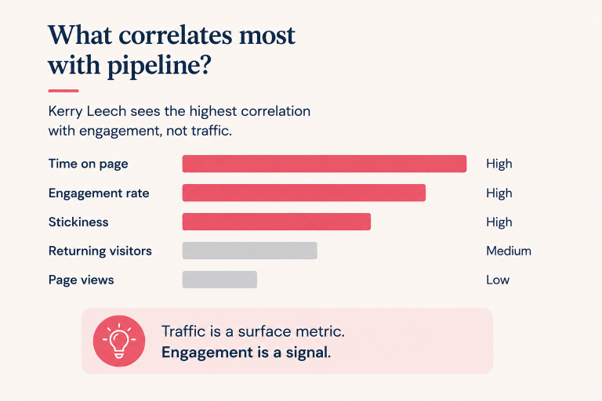
For clients using Dreamdata, we can also see which pieces of content appear throughout the buyer journey before someone books a demo or becomes a customer. Quite often, that tells a very different story from page views alone.
As Kerry puts it:
"We do tend to see the same types of content over and over again perform really well and are always there as part of the B2B buyer journey. Now we have a very solid framework for exactly what types of content you need to be creating and keeping updated and refreshed, etc., in order to generate pipeline revenue."
It's a good reminder that reporting works best when you look at a combination of signals. Traffic is one piece of the puzzle, but engagement, attribution and commercial impact often tell you much more.
One thing Kerry didn't expect
I finished by asking Kerry what had genuinely surprised her over the past few months.
Her answer wasn't what I expected.
"Some things have really changed my assumptions, actually."
One thing she keeps seeing is product update content appearing in the buyer journeys of new prospects.
"You would expect niche sector-specific content that's pain point focused, to be high-performing. But alongside this, I repeatedly see general product update posts in the journey of MQLs. I just didn't really expect it, because it feels like a lot of the time you're doing that to show existing customers the changes you're making, but actually they're pulling in new customers as well."
She was quick to add that this doesn't mean every blog should be a product update.
"I'm not saying flood your blog with just product updates, because that would be very boring, but they have a very important role to play. It shows that you're always innovating."
She's also seeing the same mix of content appearing time and again across client accounts.
It is also a real mix of different types of content that we're seeing:
• Competitive comparisons
• Pain point content
• Listicles
• Product updates
• Even press releases.
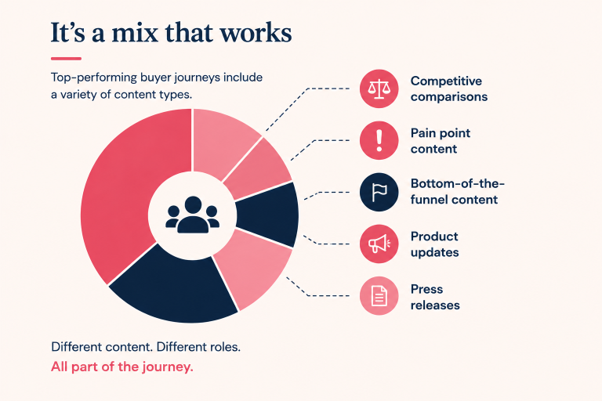
It's another reminder that there isn't a single type of content that drives pipeline.
As Kerry puts it:
"That's why it's so important to work with content specialists who know and understand exactly what content a modern B2B buyer wants to consume before they ever talk to sales."
So, what should we be measuring?
If there's one thing I took away from my conversation with Kerry, it's that content performance isn’t as simple as a dashboard makes it look. Traffic still has its place. So do open rates, click-through rates and downloads. But none of them give you the full picture on their own.
Instead, measure content in a way that reflects how your buyers actually buy.
Are they spending time with your content? Does it appear throughout the buyer journey? Is it helping generate pipeline? Is it supporting revenue?
If we're still judging content the way we did ten years ago, there's every chance we're overlooking the content that's having the biggest commercial impact.
Need a fresh perspective on your content?
We've spent years helping B2B brands create content that earns trust, answers buyers' questions and supports commercial growth.
Whether you're reviewing your content strategy or wondering what to write next, we'd be happy to share what's worked for our clients. Get in touch.