

Beyond commodity content: Why B2B brands need strategic marketing now
I use AI every day, and I'm a fan. But some research from GWI last month has stuck with me.
Over half of UK marketers (55%) told GWI their business had made a big decision based on AI-generated insight that later turned out to be wrong or misleading. Over a third had customer complaints as a result, and 29% said it led to financial losses.
Kerry and I were both heads of marketing before we set up Roo & Eve, long before AI could write a blog in seconds. So I asked our resident content super geek how we checked insight back then, and why businesses still come to us for marketing expertise.
Here's what she said ⬇️
TL;DR: the short version
If you're short on time, here's what's in this blog.
Half of UK marketers have been caught out. 55% say their business has acted on AI-generated insight that later proved wrong or misleading.
Pre-AI habits still catch mistakes. Testing ideas against your own campaign data and going back to the original source catch what AI misses.
Unchecked content costs deals. In regulated sectors like financial services, out-of-date content is a compliance risk too.
Google is calling out commodity content. The value sits in the research and planning that happen before anyone writes a word.
Buyers shortlist before they talk to sales. Content built on their pain points, and joined up with sales, earns a place on the day one shortlist.
There's a little more to it than that. Keep reading. ↓
How did heads of marketing check insight before AI?
"When I was head of marketing, I spent time every week following B2B marketers and companies on LinkedIn who were trying different things and sharing the data behind their results, often with case studies. I still do.
That showed me what was working for them. But, of course, it didn't tell me what would work for us. Their audience often wasn't our audience, and the same idea can perform very very differently in another market.
So we tested. We ran variations, checked the results in our own campaign data, and kept what our audience responded to.
That habit is more important now. AI search is changing so fast that a lot of the claims being made can't be backed up yet. (I don't think anyone has fully worked it out.)
Statistics are the other big one. A few years ago, a Google search would usually take you straight to the original research report. Now you hit 20 listicles and stats roundups first, and many don't name the source. When you go looking for it, sometimes it doesn't exist.
It's easy to produce a lot of content quickly. If nobody has checked it, all that volume is a risk. Quality has to come first."
What does unchecked AI content cost a B2B business?
"The first problem is that AI is just amplifying what was already happening. Yes, it can and does help with productivity and other things in many ways, but it also magnifies the wrong strategy.
It hardly ever disagrees with you. So will keep churning out content based on the completely wrong approach, while confidently telling you it’s all finnnnnne. 😬
AI has floored the gas pedal, but how do you know if it’s all heading in the right direction?
Another key point I’d make is that content is there to build trust in your brand and your people. Inaccuracy damages exactly that, and it goes well beyond a wrong stat.
Regulation is a good example. We recently wrote a blog for a credit risk client in financial services about the Mills Review, the FCA's review of AI. While doing our own manual research into what the FCA had announced recently, we found a more up-to-date version. We rewrote the blog around it.
If we'd relied on whatever an AI tool had in its training data, the client would have published something already out of date, in a regulated sector, under their name.
So we go to the source. We follow regulators and research bodies on LinkedIn, set up alerts and sign up to their emails, so we hear about anything new directly from them.
For a founder, that has a negative knock-on effect in a few places:
Lost deals. Prospects who spot an error stop trusting the rest of what you say.
Compliance risk. In financial services, out-of-date guidance is a liability.
Wasted budget. Content built on bad insight goes after the wrong audience or the wrong problem.
Sales clean-up. Your team ends up correcting claims mid-conversation.
Errors that travel. AI search tools repeat what's published, so a mistake can reach prospects attributed to you.
Checking takes far less time than fixing."
Where does the value lie in B2B thought leadership now?
"Google now talks openly about commodity content: pages that repeat what everyone else has already said. If you write without a strategy and without researching the topic properly, that's what you produce, and Google has little reason to rank it.
The value, then, is in the work before the writing. For every piece, we:
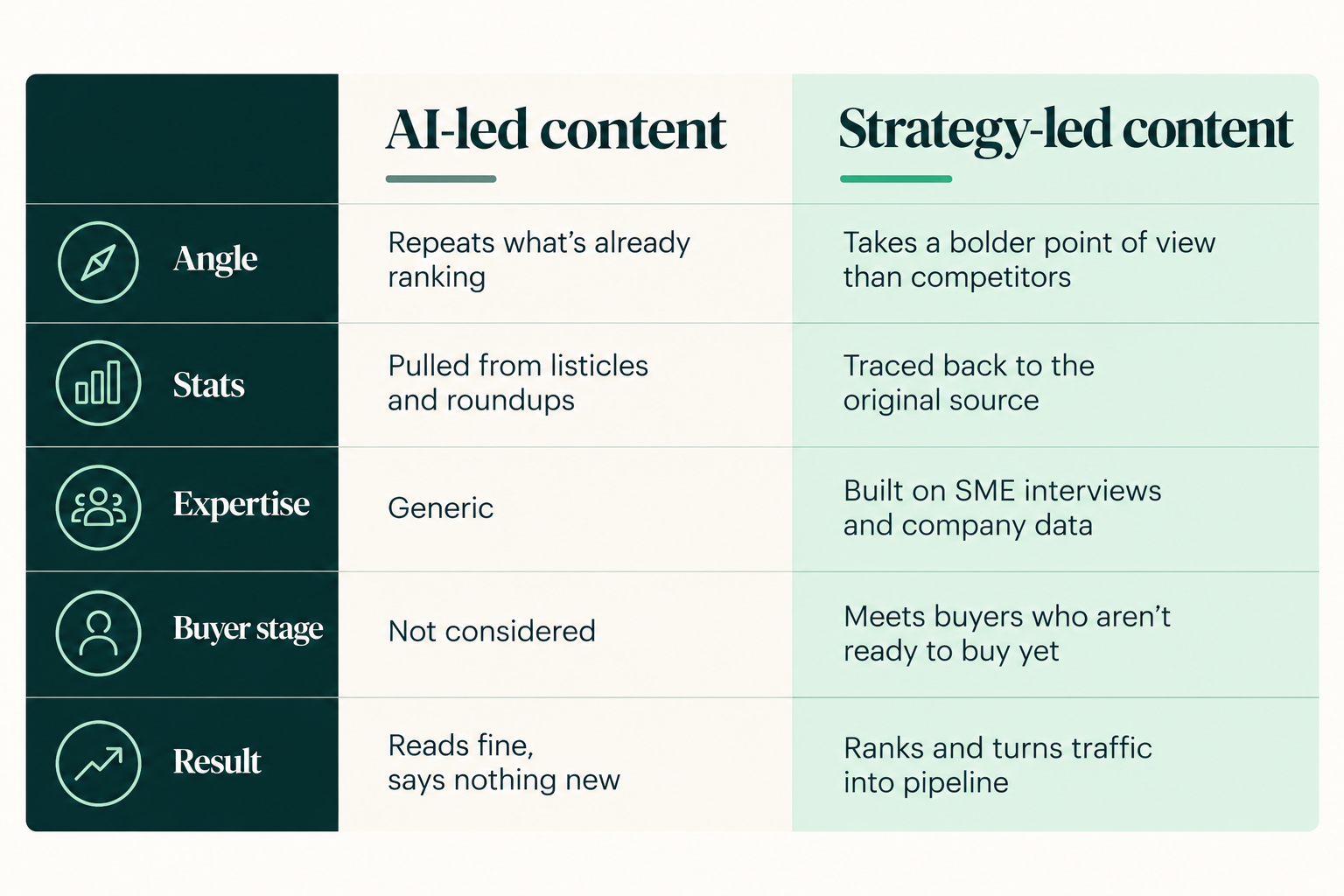
Research what's ranking. What angles are competitors taking? What's their point of view? Often they sit on the fence, which gives our clients room to say something bolder. Buyers want that right now.
Read the conversation on LinkedIn. Comments and back-and-forth give you more human insight than search results. They often point to a topic worth a whole blog of its own.
Find stats with the original source. If we can't trace it, we don't use it.
Gather industry commentary. Quotes from regulators like the FCA, and what people are saying on LinkedIn and X. We often use these snippets in the piece.
Interview the client's subject matter experts. We write those questions carefully, around the story we want the piece to tell, and follow up where we need to. If we can get data from the company, that's gold dust. It isn't always easy to get, and it's worth the effort.
Place it in the buyer journey. Most of the audience is usually in the 95% who aren't ready to buy. They're trying to understand a problem and decide whether to prioritise it. The piece has to meet them there.
Teams that treat thought leadership as a writing task skip most of that list. They end up with content that reads fine and says nothing new."
Further reading ➡️ How to create a content strategy aligned with the modern B2B buying journey
Can AI do your B2B content for you?
"The belief I push back on hardest is that AI can do your content now, so you don't need a writer or strategist.
We see content produced that way, and the first thing missing is storytelling. It sounds like everyone else using AI. It has no personality, and that frustrates me most.
Over the years, we've developed our own voice that we bring into our clients' content. It's more human. It has soul. A lot of what we see feels rushed, and it's often walls of text.
When we write, we start with the narrative. What's the story, and how do we tell it? Then we think about format, and there are a lot of rules you can't churn out of AI:
Write for scan readers. Most people skim before they commit, so no section should be a wall of text.
Keep the hooks coming. Every section needs a reason to keep reading down the page.
Break it up. Tables (before and after works well), bullet points, quotes and pull-outs.
Add a visual. We make sure every piece has an infographic or visual. They catch the eye, keep people reading and work well on social.
There's a lot in even a basic blog. We've learned what each of these pieces does over 15 to 20 years, and we've seen which ones generate pipeline and revenue.
We write content that ranks, brings in traffic and turns that traffic into pipeline and revenue. That last part is where we specialise."
Why do B2B businesses bring in marketing expertise?
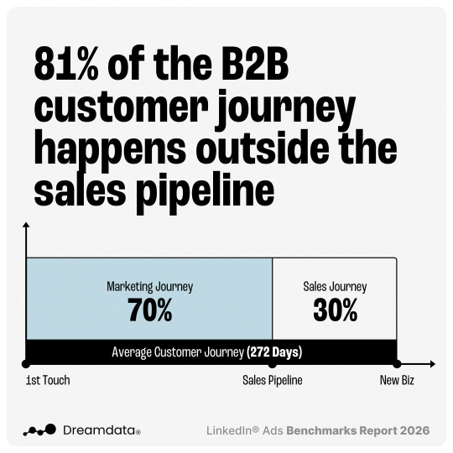
"Most of the businesses we speak to have very little content. Many don't realise how much of the B2B buyer journey happens without them.
At least 80% of that journey is done before a buyer speaks to sales. By then they've built their day one shortlist from the content they've read over the last 3, 6 or 12 months. If you weren't part of that, you get passed over.
We also see damage from generic SEO agencies. The keywords they target are often ones consumers search for, not the client's actual buyers.
Our clients tend to be specialist and technical, often enterprise businesses with long sales cycles and high order values. Their buyers need convincing, and nobody makes a decision that size on a hunch.
A good writer can adapt to most audiences. Writing for niche technical buyers takes specialist knowledge, and that's what we bring, along with our SEO and AI search expertise.
That thinking shapes what we produce. When we look at our own clients, and which content has contributed to pipeline and revenue, 85 to 90% of it is built on the pain points the audience is dealing with.
We do our best work when we're joined up with a salesperson or sales team, creating content that feeds into their nurture sequences. Marketing falls down when it works in a silo, cut off from sales and the other channels.
Integration is what Kerry was named marketer of the year for at Experian back in 2014. As she notes, twelve years on, most businesses still aren't doing it.
Before you hand your content over to AI
Most of what Kerry talks about happens before anyone writes a word. It's the work we did as heads of marketing, and we bring it to every client now.
If you'd like senior marketing expertise behind your content, take a look at our services or book a consultation. Your first one is free.