

Everyone’s super productive right now. (Or at least it feels that way.) You can create 10 ad copy variations before lunch and a month of LinkedIn posts by the afternoon. Meanwhile, the rules keep moving. How Google ranks content, which sources ChatGPT and AI Overviews pick, what counts as spam this month. (It’s all coming at us at a rate of knots.)
So a lot of brands have started writing for the machines. Tighter templates, more listicles, fewer people in the words. Some of it works for a while. Plenty of it has already backfired.
We’re Kerry and Becca, and together we run Roo & Eve. We write content for B2B data, tech, and credit services firms. It ranks in Google, gets cited in AI search, and brings in leads, pipeline, and revenue. And…. super importantly, and it’s absurd I have to say this, but it’s written for a real person to read.
Yes. You can do both. It just takes more time, consideration, and effort.
Short on time? Here’s the gist:
Content written only for AI search is backfiring. Google demoted self-promotional listicles in early 2026.
Most of what Google ranks and AI tools cite is still written by people.
You can write for both. Our clients’ content brings in leads and shows up in Google and AI answers.
Most of the effort goes in before anyone writes a word.
You can download a short PDF version here or keep reading to the full story. ⬇️
Why is content written for AI search starting to backfire?
When AI search took off, B2B brands went looking for whatever got them mentioned. One tactic spread fast: the self-promotional listicle. “The 10 best [category] tools for 2026”, written by one of the tools, with that tool at number 1.
For a while it worked. Those pages ranked in Google and got pulled into AI answers, so brands published more of them. Hundreds, in some cases.
Then in January 2026, Google started demoting sites. Search Engine Land reported that several SaaS brands lost between 29% and 49% of their organic visibility within weeks. SEO pro Lily Ray, who first spotted the trend, has since found dozens of companies that had scaled up these pages. (One had around 2,000.)
The AI platforms haven’t all followed, which makes it harder to plan around. Data from Peec suggests self-promotional listicles are still being cited across ChatGPT, Perplexity, Gemini and AI Overviews. So the same tactic can be punished in one place and rewarded in another, in the same month.
That’s the rate of knots I mean. Brands chase whatever’s working this quarter, rewrite their content around it, and then the rules move again. Each time, a little more of the person drops out of the writing.
And the people reading it haven’t changed at all.
➡️ Related reading: Beyond commodity content: Why B2B brands need strategic marketing now
Does low-effort content rank in Google and get cited by LLMs?
One SEO agency, Graphite, has tracked this since ChatGPT launched. Its research suggests roughly half of all new articles online are now mostly AI-written. When it looked at what ranks in Google, and what ChatGPT and Perplexity cite, things look very different. More than 8 in 10 of those articles were written by people.
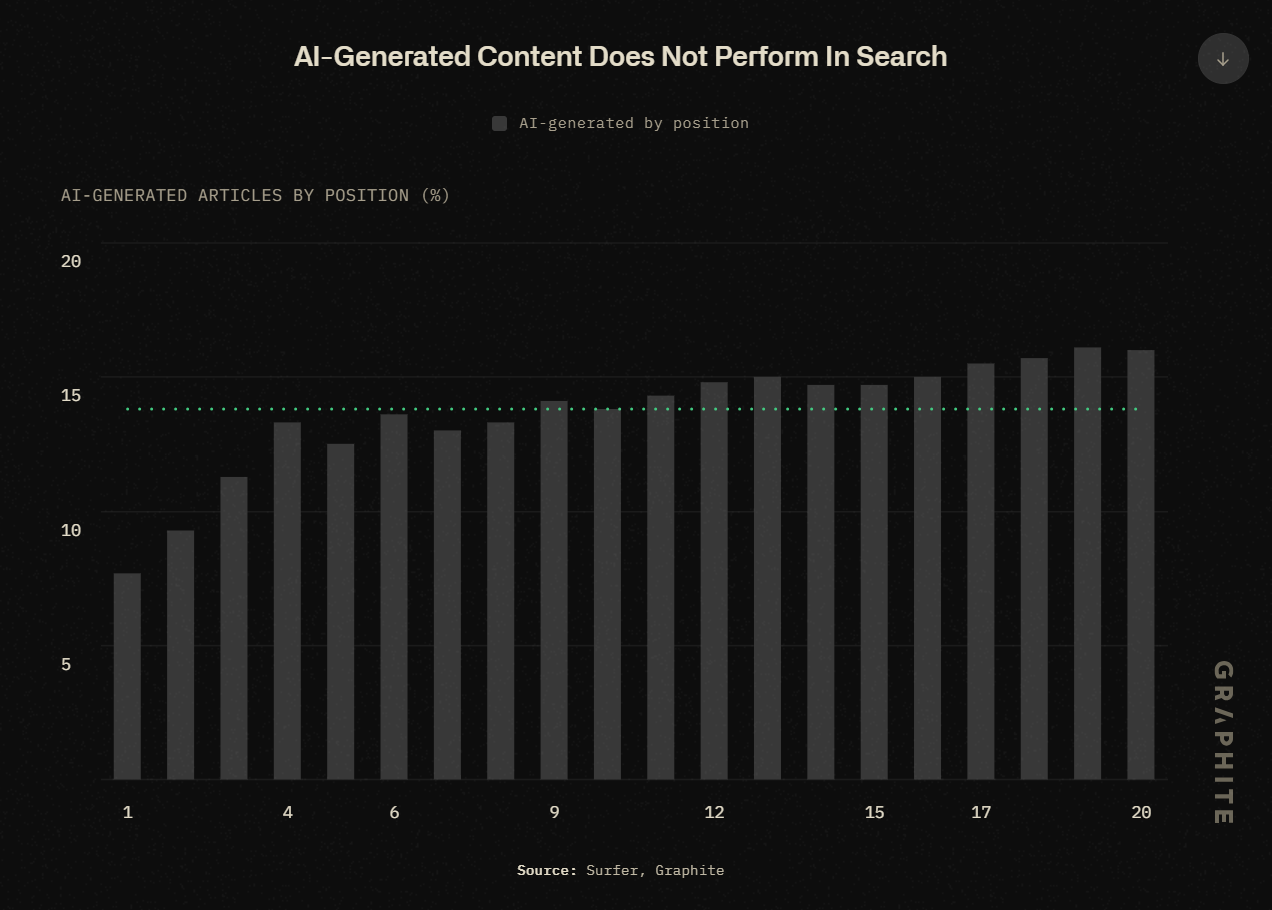
Of course, they rely on AI detectors, which aren’t perfect. And Graphite didn’t test AI-assisted content that has been heavily edited by a person. Other research suggests most top-ranking pages contain at least some AI-generated text.
That fits what we see.
Using AI as a helper is normal now, and we use it for things like early research and creating content angles and outlines (under our very specific instructions).
Google says much the same. In October 2026 it updated its guidance on generative AI content. It now says AI-generated content should be fact-checked and reviewed by hand before it goes live, right down to titles, meta descriptions and image alt text. Its guidelines for quality raters class large amounts of AI text published without human oversight as little to no effort.
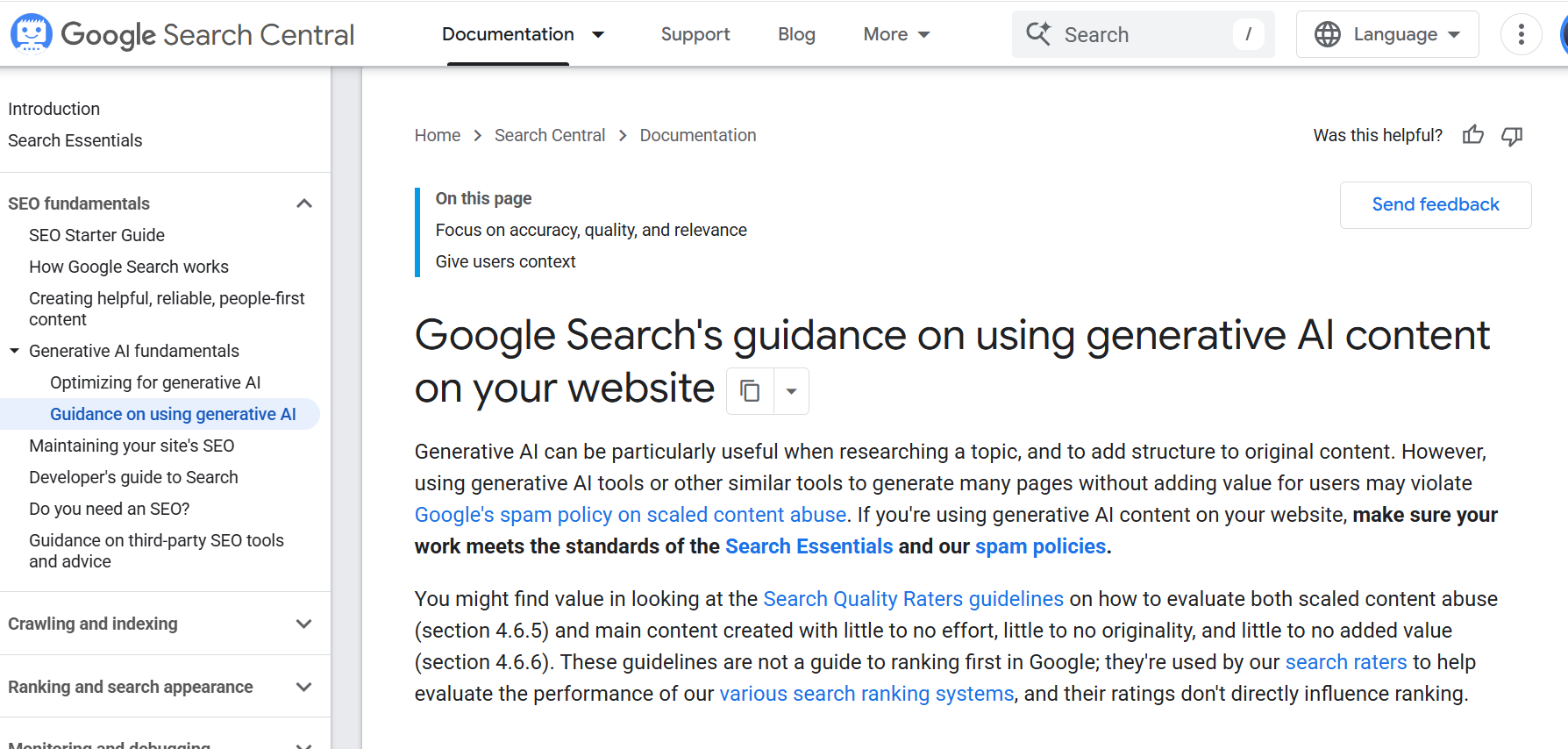
So Google and the AI platforms are favouring the same thing: content with a real person behind it.
➡️ Read more: The real limits of AI in B2B marketing
What happens to brand voice when you prioritise writing for bots?
A few years ago, I wrote for one of the leading project management platforms. They were always rigorous. Every blog followed a set structure, and we stuck to it.
However, there was still room for a friendly transition between sections, an aside, a question to the reader. The small touches that make you feel someone is talking to you.
Their blog looks very different now. 🙈
The structure’s still there, tighter than ever, and the transitions have gone. Every post reads as if it was built for an AI model to scrape. You could swap their logo for a competitor’s and nobody would notice.
That’s the cost of writing for bots. Brand voice is one of the few things a competitor can’t copy, and tends to be the first thing to go when every piece follows a formula built for machines.
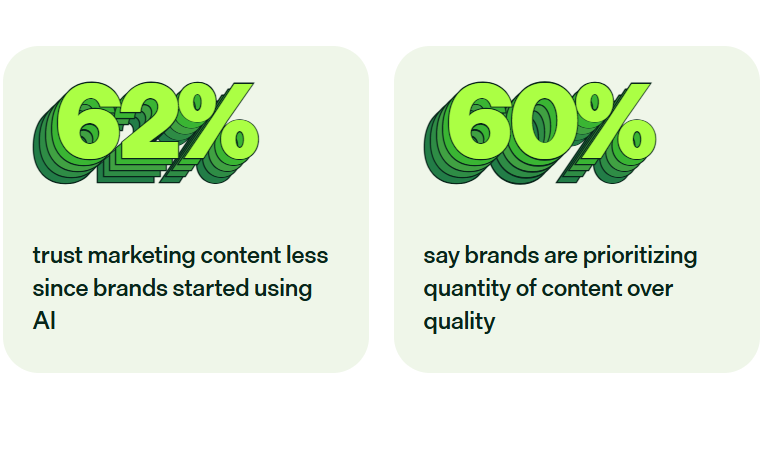
Readers notice. In a recent Optimizely survey of UK consumers, around 6 in 10 said they trust marketing content less since brands started using AI. Two-thirds felt brands were putting volume ahead of quality, and more than half said they can usually tell when something has been written by AI.
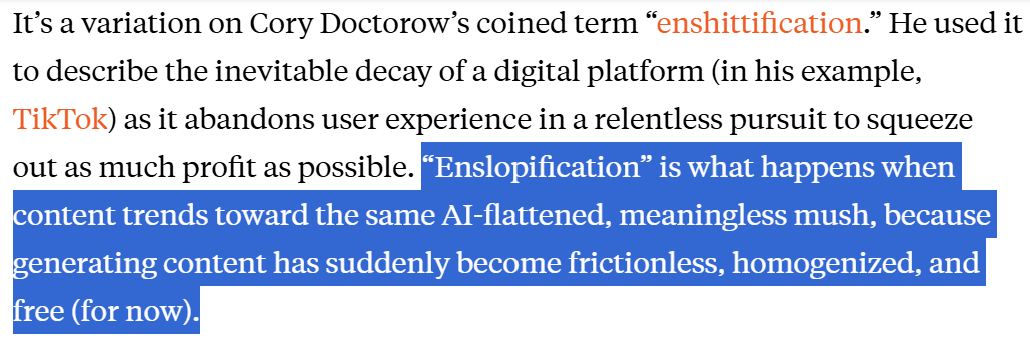
Fast Company has called this the “enslopification” of B2B marketing. When anyone can publish instantly, it turns into a race to the bottom, and everyone ends up sounding the same.
Can you write for AI search and humans at the same time?
Yes. It just takes more effort, and we do it every day.
Some people in the industry argue that writing for machines is now the sensible choice. People click through less when an AI summary has already answered their question, so why not write purely for AI to pick up? Short, dense pages with nothing personal in them.
But across our clients we’ve seen something different. The same pieces bring in marketing qualified leads, rank in Google and turn up in AI Overviews and ChatGPT answers. How well they perform can depend on the sector, how much authority the site already has, and whether the client has their own data to share.
What it does take is effort in the right places, and that’s where a lot of teams fall down.
As Lily Ray puts it;
“Nobody likes this answer, because it requires real work, real time, and patience. It’s like fitness — the rapid-results diet hack usually doesn’t hold, and people yo-yo.”
The Content Marketing Institute’s 2026 B2B research found that nearly all B2B marketers now use AI, and fewer than 4 in 10 say it’s improving their performance. Plenty of output. Not much to show for it.
Similarly, Robert Rose, who co-founded the Content Marketing Institute, made a point on the Humans of AI podcast that stuck with me: “Robert argues that AI is the first technology in 20 years inviting us to slow down, get deeper, and become more creative.”
What does a B2B content process that ranks, is cited, and generates revenue look like?
With all that in mind, let’s get to the good stuff. Here’s what goes into every piece we write. (You can download a PDF checklist version here.)
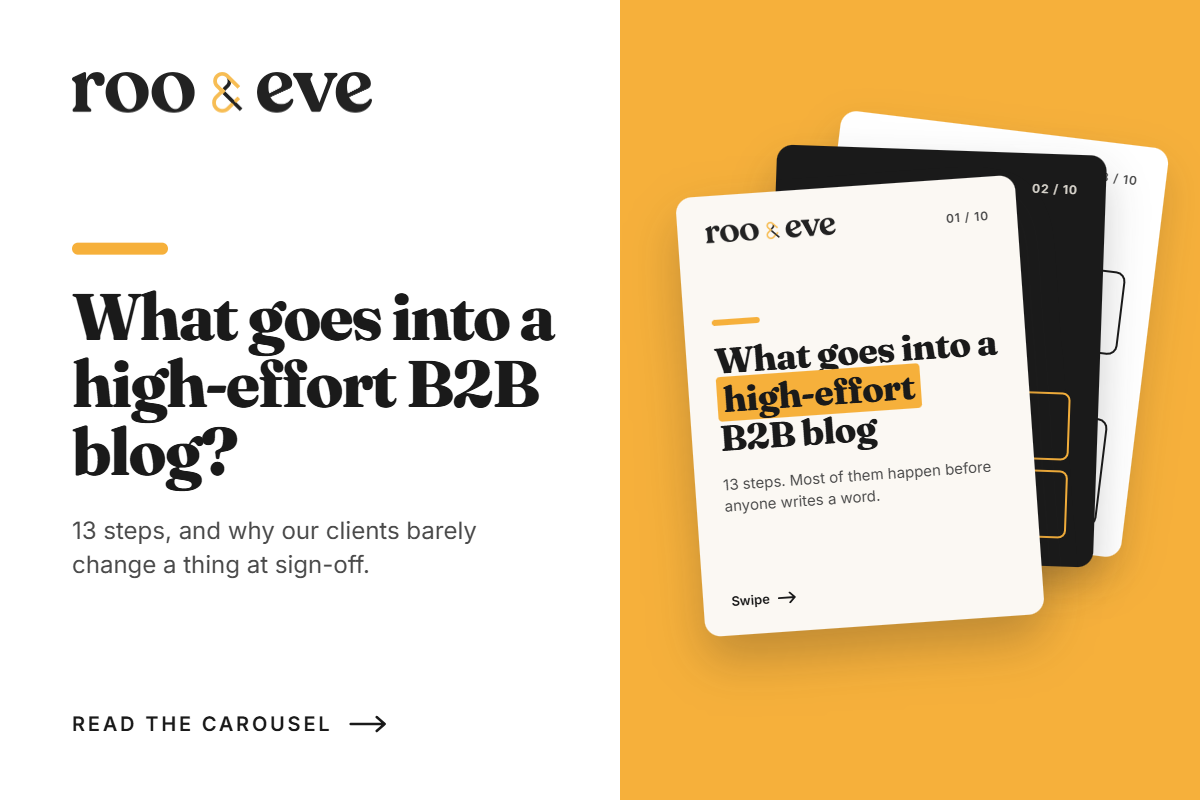
Start with a documented strategy. Before any article idea, we agree the pillars the brand wants to be known for and map them to the specific pain points of its ideal customers. Every piece ties back to that, so the content works together instead of being a pile of random ideas.
Research what’s already out there. We look at what’s ranking in Google and what the LLMs say about the topic. Which angles are people using? What’s missing? We’re looking for the information gain: something new to add instead of repeating what everyone else has said.
Interview the experts. We talk to subject matter experts at the client, and sometimes to consultants who work with them. This is where the point of view comes from. It’s important to avoid sitting on the fence too!
Build a strawman and outline. We shape the argument first, then the structure. Question-led headers and the right keywords help Google and the LLMs understand the piece, and we make sure the outline still reads exceptionally well for a person.
Write in the client’s voice. We follow their brand guidelines and core pillars and add personality. We want a reader to finish and think, “Yes, that sounds like them.” A quick test would be to think: if you remove the brand name, could this have been written by anyone?
Back it up. Statistics and industry commentary from original sources, including when we disagree with something. When a client has their own data, we use it. It’s hard to come by, and it’s worth chasing: Search Engine Land found that primary research earns 3.3x more AI citations per page.
Bring in real conversations. We look at what people are saying about the topic on LinkedIn and X, and often embed their posts so readers hear from practitioners directly.
Fact-check everything ourselves. AI can help with research, but it gets things wrong, so we check every claim at the source. Google now asks for the same: human review of AI-generated content before it’s published.
Edit, then swap. We each edit our own work several times. Then Becca reviews mine and I review hers, so every piece gets a fresh pair of eyes.
Create the visuals. Bespoke images and on-brand infographics that tell part of the story by themselves. I’ve spent 4 hours on the images for a single article before. It sounds a lot, and it’s worth it when someone understands the point at a glance.
Link it into everything else. Internal links connect each piece to the rest of the client’s content, so readers and search engines can see how it all fits together.
Repurpose it for every channel. One article becomes LinkedIn carousels, newsletter content and material for the sales team. Each channel gets the format that works there, and the message stays the same everywhere.
Measure and refresh. We track how each piece performs, from leads to mentions in AI answers, and go back to update it so it stays accurate and useful.
That’s a lot of steps, and most of the work happens up front. You can see the result at sign-off: clients usually approve with hardly any changes, because by the time a draft reaches them it already sounds like them and says what they want to say.
➡️ Related reading: 15 touchpoints before a demo: what B2B buyers do before they raise their hand
How do you write B2B content for a reader who’s short on time?
I know it’s a cliché, but I always picture one person. One reader with one problem, who probably hasn’t got much time.
Everything else follows from that. How do I get this across in as few words as possible? How do I keep them reading? Where can some personality come through?
The rule I keep coming back to is: don’t make me think. (I bloody love that book). If a reader has to stop and work out what a sentence means, or why a section is there, I’ve lost them.
The second rule is to have an opinion. Content that won’t take a side is easy to forget. Readers want to know what you think, and the LLMs look for direct, quotable statements too.
Then there’s the fact that most people won’t read every word. Nielsen Norman Group’s research found that in an average visit, people have time to read only around a quarter of the words on a page, at most.
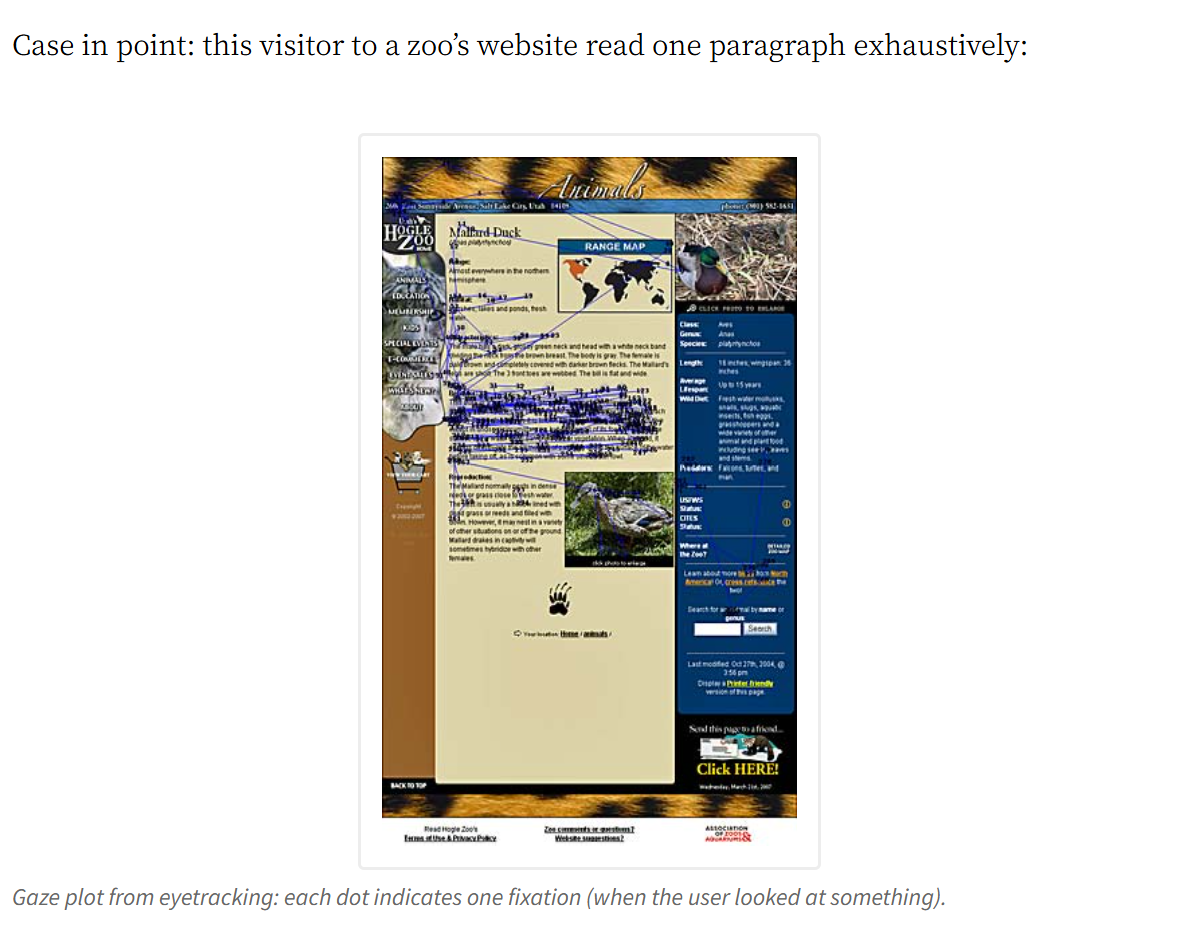
So the headers have to tell the story by themselves. Someone who only skims the subheadings should still come away with the argument.
That’s also why we put so much into the visuals. There’s nothing worse than a wall of text. A good infographic gives a skimming reader something to stop on, and often explains the point faster than a paragraph could.
➡️ Read more: Stop focusing on bots and start talking to humans
Why does high-effort content start with the writer?
I know this might sound a little unusual in a B2B blog, but for me it’s the most important part.
Before I start work, I do a short grounding meditation every day. It settles me, and I need a calm head to pull the right threads when I’m researching and writing.
I notice it most in the research. When I’m grounded, research feels intuitive. A search phrase comes to mind, then a website, then a link from that website, and I follow them. That’s often where I find the angle nobody else has covered.
Being coherent in yourself first means you know what you’re trying to say and why. Then the work holds together.
Martin Fowler, who has written about software development for decades, makes a related point in his piece on LLM voice. For him, writing is how he thinks things through, and he worries that people who hand their writing to an LLM will end up handing over their thinking too. The thinking is the part clients are paying for.
Do B2B buyers care whether content is high effort?
B2B buyers judge vendors on the quality of what they publish, and weak content costs deals.
The 2026 Edelman and LinkedIn thought leadership research, published in November, found that almost 6 in 10 decision-makers said low-quality thought leadership, or none at all, had contributed to a vendor being dropped from consideration. Those vendors were out before a salesperson ever got a call! They literally didn’t make it onto the Day One list because of low effort content.
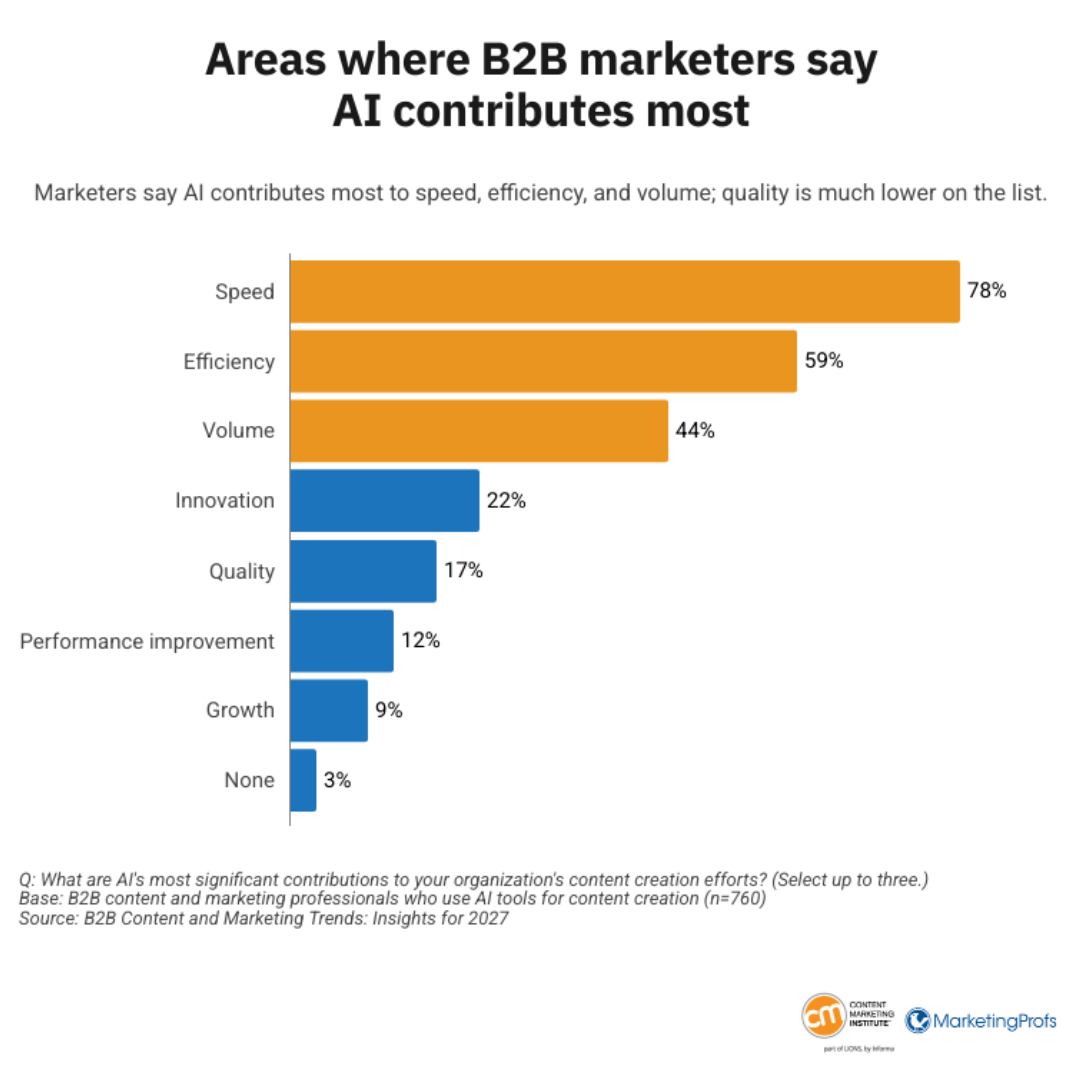
The marketers getting results seem to know this. In research from the Content Marketing Institute, those who rated their marketing as effective gave far more credit to content quality and their team’s skills than to AI tools.
The platforms are going the same way. In March 2026, LinkedIn updated its feed to show less recycled, low-substance content, because it wants people to know they’re engaging with a real person and a real point of view.
When someone is deciding who to trust with a big contract, your content is often their first look at how you think.
Create high-effort content to really move people
Watch enough Dragons’ Den and you’ll hear the same thing again and again: getting people to change their habits is hard, even when the change is good for them.
B2B content asks for that every time. We want a reader to rethink how they work, or to put a new supplier in front of their boss. And this only happens when the content reaches them as a person. It has to come from people who understand the subject and care whether the reader is better off for reading it.
That’s why we put love and soul into everything we write. When it works, it’s one soul talking to another.
Let’s make your content count
Roo & Eve writes high-effort B2B content that ranks, gets cited, and generates pipeline. Talk to us. We’d genuinely love to help.